Compare RIPPA mini excavator models including R06-1 ECO, R10-6 ECO, R13-4 PRO, R15-5 ECO, R18-5 PRO, R22-3 PRO, R32-4 PRO, and R57-2 PRO. Learn how to choose the right machine based on job type, attachments, work space, and long-term value.
For many buyers in North America and Europe, the hardest part of buying a mini excavator is not deciding whether to buy one. It is deciding which model actually fits the work.
At first glance, compact excavators can look similar. But in real-world use, the differences are significant:
digging capability, attachment compatibility, transport convenience, jobsite access, operator comfort, and return on investment all vary from model to model.
That is why the smartest way to choose a RIPPA mini excavator is not to start with price. Start with the job.
Here are the four questions every buyer should ask first:
Backyard trenching, pool digging, tree planting, drainage work, farm maintenance, fencing, foundation prep, or light commercial work?
A machine is only as useful as the tools it can run well. Buckets, augers, grapples, breakers, rakes, and tilting buckets can make a huge difference in productivity.
This matters more than many first-time buyers expect. In residential markets, side-yard access, gate clearance, turf protection, and trailer convenience are often major decision points.
Homeowners often care most about simplicity, compact size, and ease of ownership. Contractors care more about uptime, versatility, jobsite performance, and long-term payback.
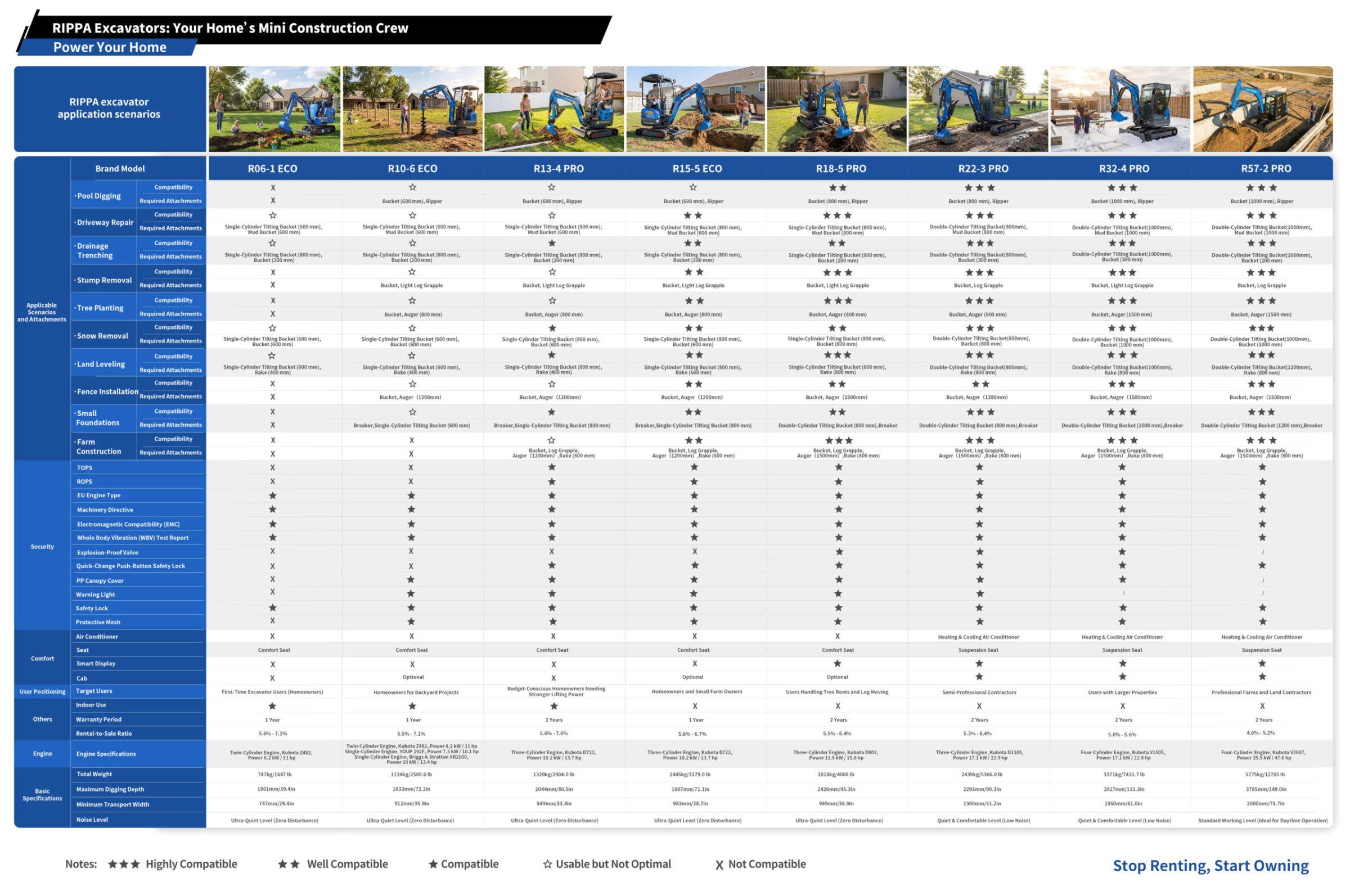
Based on the RIPPA comparison chart, these models can be understood in four practical buying categories.
These models are ideal for:
Who are they best for?
If a customer is new to excavators and mainly working on home projects, garden improvements, light digging, and occasional property maintenance, these are often the easiest models to recommend.Buying tip:
Why these work well in Western markets:
They align well with the needs of homeowners, DIY landowners, and buyers looking for a compact machine that is easy to tow, easy to learn, and practical for small properties.
This is the category many buyers spend the most time comparing, and for good reason. It often delivers the best balance of power, versatility, and ownership value.
These models are well suited for:
Why this category matters so much:
Most buyers do not need a machine for only one task. They need one machine that can trench one day, level ground the next day, and handle attachments across different seasons.That is where this range becomes attractive.
Buying tip:
Typical buyer profiles in the U.S. and Europe:
If the machine is expected to do more than occasional work, this is where many professional buyers start paying close attention.
These models are a stronger fit for:
Why contractors look here:
Buying tip:
For customers focused on:
the R57-2 PRO stands out as the professional-grade option.
These buyers are usually less focused on the lowest purchase price and more focused on:
Focus on:
Best starting points: R06-1 ECO, R10-6 ECO, R13-4 PRO
Focus on:
Best starting points: R15-5 ECO, R18-5 PRO, R22-3 PRO
Focus on:
Best starting points: R18-5 PRO, R22-3 PRO, R32-4 PRO
Focus on:
Best fit: R57-2 PRO
In real work, the right attachment setup often matters just as much as the base machine.
Ownership cost also includes transport, storage, maintenance, service access, and usable flexibility over time.
A lot of buyers start with backyard jobs, then move into drainage, fencing, grading, or paid work. Choosing too small can become expensive later.
For occasional use, comfort may seem secondary. For frequent use, seat quality, controls, visibility, and operating environment directly affect productivity.
For dealers, a visual model guide is not just a brochure. It is a sales tool that helps customers understand differences fast and make decisions with more confidence.
This RIPPA chart works well because it turns a complicated buying decision into a simple visual conversation.
It helps dealers:
For dealerships, this kind of printed material is especially effective in:
In Western markets, buyers respond well to comparison tools that help them self-educate before talking numbers. A chart like this makes that easier.
The best way to choose a RIPPA mini excavator is simple:
Start with the job, then the attachments, then the work space, and only then the budget.
For most buyers:
And for dealers, this is more than a comparison chart. It is a practical in-store sales asset worth printing and displaying.
Tel: +8615628788742
E-mail: contact02@rippa.com
WhatsApp: Escavadeira Rippa
Endereço: O sexto parque industrial, cidade de Jining, província de Shandong, China

 PT_BR
PT_BR  EN
EN  ES
ES  IT
IT  FR
FR  RU
RU  DE
DE  PT
PT  TR
TR  BG
BG  HR
HR  RO
RO  CS
CS  NN
NN  SL
SL  SV
SV  HU
HU  SK
SK  DA
DA  FI
FI  PL
PL 
