Landscaping projects often involve working in areas where space is limited and existing surroundings must be protected. Residential gardens, commercial outdoor spaces, parks, and property improvement sites may not have enough room for large construction equipment.
A mini excavator for landscaping can help contractors handle digging, soil removal, trenching, and ground preparation more efficiently.
Its compact design makes it a practical equipment category for businesses that regularly move between different outdoor projects. Instead of relying entirely on manual labor for excavation tasks, landscaping contractors can use compact machinery to support repetitive ground work.
However, choosing the right machine requires more than looking at its size. Buyers should consider site access, soil conditions, required attachments, transportation, and the type of landscaping work they perform most frequently.
Mini excavators can support a variety of outdoor construction and landscaping applications.
Preparing a garden may require removing unwanted soil, digging planting areas, and reshaping sections of the ground.
A compact excavator can assist with these tasks, especially when contractors need to work around existing landscaping features or within residential properties.
Before selecting a machine, consider the available access space and the amount of soil that needs to be moved.
Landscaping businesses may need to prepare planting holes for trees and larger shrubs.
A mini excavator can help with excavation work where the required digging area is suitable for the machine and its attachment.
The contractor should consider the required hole dimensions, soil conditions, and proximity to underground utilities before beginning work.
Installing irrigation systems and drainage lines often involves digging narrow trenches across gardens, lawns, and outdoor spaces.
A mini excavator equipped with a suitable bucket can support this type of work.
Contractors should confirm the required trench dimensions and attachment compatibility before selecting their equipment.
Landscaping projects frequently include pathways, patios, retaining walls, and other outdoor structures.
Excavation and ground preparation are important early stages of these projects. A compact excavator can assist with removing soil and preparing areas for subsequent construction work.
Property maintenance companies may handle different types of outdoor work throughout the year.
A mini excavator can be considered for small-scale digging, drainage improvements, and general ground preparation, helping businesses expand the services they can provide.
Not every landscaping project requires the same machine. Buyers should evaluate several factors before selecting a model.
Access is one of the most important considerations for landscaping equipment.
Residential properties may have narrow gates, garden paths, fences, or existing structures that restrict machine movement.
Before purchasing, measure the access route and compare it with the actual machine dimensions.
Also consider whether the excavator will need to turn or reposition frequently within a confined working area.
Different landscaping projects involve different ground conditions.
Soft garden soil, compacted ground, gravel, and uneven terrain may place different demands on the machine.
Buyers should discuss their typical working environments with the manufacturer and confirm whether the proposed machine configuration is appropriate.
Ground conditions also influence the choice of tracks, buckets, and other working attachments.
Attachments can make a mini excavator more useful across different landscaping tasks.
Depending on the machine and compatibility requirements, buyers may consider:
Not every attachment is compatible with every excavator. Confirm connection requirements and available options with the supplier before ordering.
Landscaping contractors often move equipment between customer properties.
Transportation arrangements should therefore be part of the purchasing decision.
Consider the available transport vehicle, loading arrangements, machine dimensions, and local road regulations.
For equipment dealers, transportation requirements are also useful information to discuss with customers before a sale.
A machine used regularly for landscaping work needs practical maintenance arrangements.
Review the operator controls, access to routine maintenance points, product manuals, and availability of spare parts.
For businesses with multiple machines, consistent maintenance information can also simplify equipment management.
The choice between a mini excavator and a larger excavator depends on the scale and working conditions of the project.
| Comparison | Minikoparka | Larger Excavator |
|---|---|---|
| Working space | Better suited to many confined sites | Generally requires more space |
| Residential gardens | Often a practical option | May be difficult to position |
| Small trenching tasks | Suitable when correctly configured | May be more equipment than required |
| Large excavation projects | Depends on the project requirements | Often better suited to larger workloads |
| Transportation | Generally easier to arrange | Usually requires more planning |
For landscaping contractors who mainly work on residential and small commercial projects, a compact excavator may be worth considering.
For large-scale earthmoving or extensive site preparation, a larger machine may be more appropriate.
The best choice depends on the actual workload rather than the machine category alone.
Before purchasing a mini excavator for landscaping, prepare a checklist based on your daily operations.
Project requirements: Identify the most common tasks, such as garden excavation, trenching, planting preparation, and grading.
Site access: Measure gates, pathways, and other restricted areas.
Machine configuration: Confirm the actual engine, hydraulic system, operating arrangement, and other relevant product details.
Attachment compatibility: Make sure the required working tools are available for the selected machine.
Transportation: Check how the equipment will be delivered to different jobsites.
Supplier support: Ask about spare parts, technical documentation, and the process for handling product questions.
For businesses purchasing multiple machines, also confirm whether the manufacturer can provide consistent configurations and clear order documentation.
Finding the right equipment is only part of the purchasing process. Buyers should also evaluate the company supplying the machine.
A reliable manufacturer should be able to explain its product range, provide accurate configuration information, and communicate clearly about international orders.
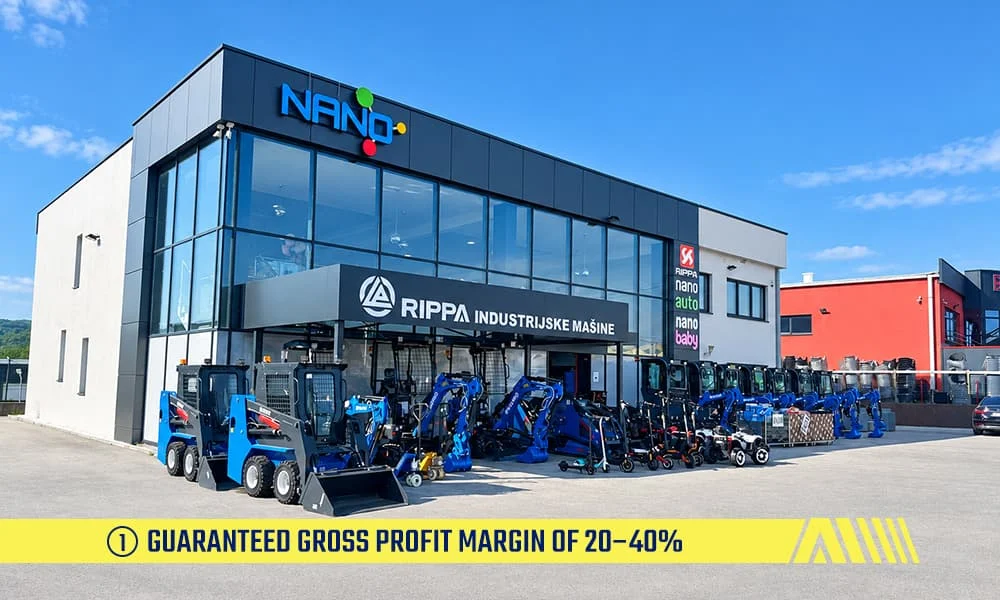
RIPPA Group is a Chinese construction machinery manufacturer headquartered in Jining, Shandong, China. Its product portfolio includes mini excavators, larger excavators, skid steer loaders, and wheel loaders.
Landscaping contractors, equipment dealers, and overseas distributors interested in compact excavation equipment can contact RIPPA to discuss available models, configurations, and purchasing requirements.
Before requesting a quotation, prepare information about your typical landscaping applications, destination country, preferred machine configuration, and attachment requirements. This makes it easier to identify equipment that matches your business needs.
Yes. A mini excavator can support landscaping tasks such as soil removal, trenching, planting preparation, drainage work, and outdoor construction. The suitable machine depends on site access and project requirements.
The appropriate size depends on the available working space, soil conditions, digging requirements, and transportation arrangements. Buyers should compare actual machine dimensions and capabilities before choosing a model.
Common options include digging buckets, narrow trenching buckets, grading buckets, and compatible augers. Availability and compatibility should be confirmed with the manufacturer.
A compact excavator may be suitable for many residential landscaping projects. However, contractors should check access width, ground conditions, underground utilities, and the machine’s operating requirements before starting work.
Ask about available models, machine configurations, attachments, product documentation, shipping arrangements, spare parts, and technical support.
Tel: +8615628788742
E-mail: contact02@rippa.com
WhatsApp: Koparka Rippa
Adres: Szósty park przemysłowy, miasto Jining, prowincja Shandong, Chiny

 PL
 EN
 ES
 IT
 FR
 RU
 DE
 PT
 TR
 BG
 HR
 RO
 CS
 NN
 SL
 SV
 HU
 SK
 DA
 FI
 PT_BR

